
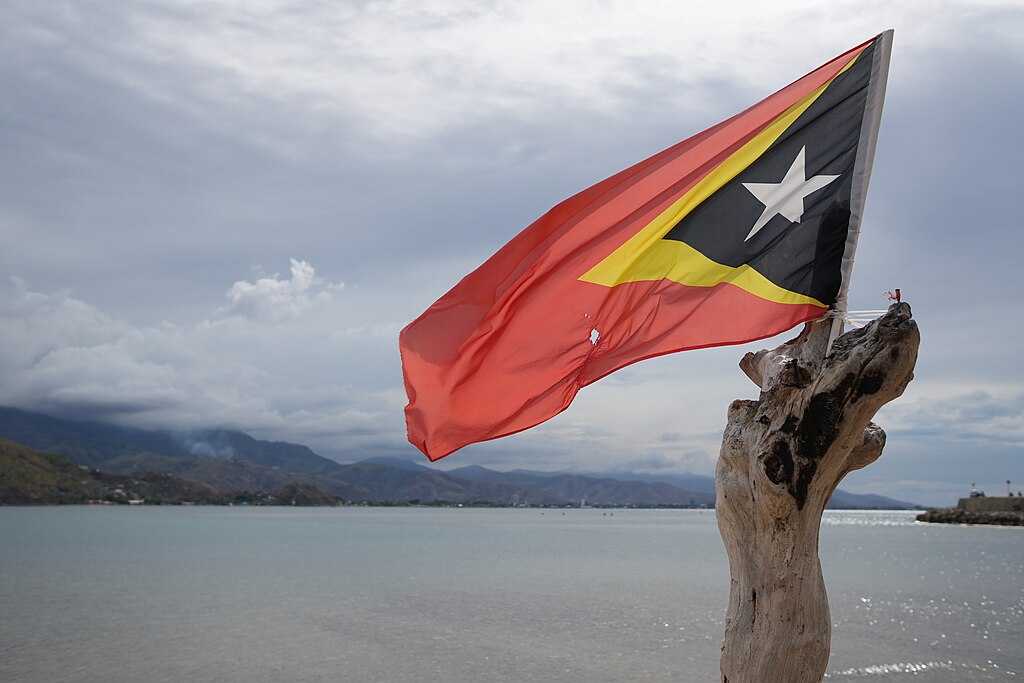
Language is at the forefront of decolonisation, and the promotion of local languages is a key tool in strengthening national identity and breaking away from former rulers. This trend can be seen across the globe, from Kyrgyzstan to Sri Lanka, yet one small nation in South East Asia stands in stark contrast to this trend – Timor-Leste. Since 2002 Timor-Leste has gambled on a linguistic policy which favours Portuguese, despite the fact that at the time as few as 5% of the population were proficient in the European language. Yet despite the policy initially raising eyebrows, it continues to be strategically beneficial for the small nation, working to open global opportunities and combat Indonesian soft power.
Timor-Leste is a small nation of 1.4 million people, located on the eastern half of the island of Timor, part of the Indonesian Archipelago in South East Asia. After centuries under Portuguese colonial rule, the left-wing Fretilin Party declared independence in 1975. This sovereignty was short lived, though, lasting only nine days before Indonesia invaded under the guise of fighting communism. This began a brutal occupation in which over 102,000 people were killed, ending in 2002 when Timor-Leste declared independence for the second time after UN intervention.
The subsequent Constitution of East Timor stated that Tetum and Portuguese were the nation’s official languages, despite the fact that the UN reported just 5% of the population were proficient in Portuguese. In addition to Tetum, the local language spoken by the majority of the country, an estimated 32 indigenous languages are also spoken. Indonesian was demoted to a working language, recognising its widespread use while not institutionalising or encouraging it. Naming Portuguese as an official language was a political decision and the start of a consistent policy by Timor-Leste’s government to promote the former colonial language.
Timor-Leste joined the Community of Portuguese Language Countries (CPLP), solidifying its position as a Lusophone nation, and has consistently passed legislation to increase the language’s use. Most recently in 2023 the 2008 Basic Education Law was changed to legally require Portuguese as the primary language of teaching, with Tetum being only used in support. Other CPLP nations, in particular Portugal and Brazil, have supported this and in 2014 they established the CAFÉ (Cantros de Aprendizagem e Formção Escolar) programme which provided teachers, funding and resources to implement Portuguese in schools. This programme was repeatedly expanded across Timor-Leste and also complemented by the subsequent PRO-Português Project, also providing resources needed to teach Portuguese.
Timor-Leste’s Lusophone policy was a deliberate and strategic geopolitical strategy, seeking to reduce the influence and soft power of Indonesia. During its occupation, Indonesia tried to discredit and erase the idea of Timorese sovereignty, which included banning Portuguese in favour of Indonesian. At the time of the second declaration of Independence in 2002 over half of Timor Leste’s population spoke Indonesian, giving its neighbour a high capacity to exert soft power and influence from Jakarta. Prioritising Portuguese represents restored sovereignty and a reversal of Indonesian influence, and its impact is more than symbolic.
A distinctly separate national language helps to cultivate a strong Timorese national identity, separate from Indonesia. And it is institutionalised as the language of official proceedings, in the wording of constitutional documents, and in how they remember the past, recentring their archived history away from Jakarta’s influence.
Education is central to this recalibration. An Indonesian-speaking education system results in students with a cultural and political identity tied to Indonesia, reducing sovereignty and increasing Jakarta’s influence. Portuguese not only reduces this, but opens up opportunities for further education in Brazil and Portugal which might have otherwise been difficult to access. Through the CPLP, study and work visas are significantly more accessible to the population. Media and pop culture are another form of influence, with Indonesian news outlets and popular culture being widely consumed in Timor-Leste. Institutionalising Portuguese opens the country to an alternative cultural sphere, preventing the Indonesian political outlook from dominating the cultural environment.
Of course, their linguistic policy does not cut off Indonesian influence, which is undeniably still prevalent, but it does create a clear distance which is enough to reinforce Timor-Leste’s independent identity and sovereignty.
Membership of the Lusophone world also comes with economic, educational, and diplomatic benefits. The union has guaranteed Timor-Leste diplomatic support from Portugal and Brazil, bringing in aid, investment, and economic and military support. As the only Portuguese speaking nation in Asia, Timor-Leste has established itself as a key diplomatic bridge for Brazil and Portugal to ASEAN nations. This increases its diplomatic reach and influence beyond what it might have achieved had it been aligned with Indonesia.
It should be noted that the policy has not been without criticism. Especially in rural regions, it has been challenging to close the gap between policy and practice. Despite support from CPLP nations, many schools and teachers remain unequipped to teach Portuguese, often lacking proficiency themselves. The government has failed to provide the necessary training and resources needed to enforce its policy. Additionally, Portuguese requirements risk creating barriers to opportunity for those without the resources to learn, isolating communities and reinforcing elitism and inequality.
Yet in spite of this the language does seem to be growing. According to Agência Noticiosa de Timor-Leste, the nation’s official news outlet, President Ramos-Horta stated that as of 2025 more than 30% of the population spoke Portuguese, a major increase from the time of independence.
Change might be slow, but that is to be expected when reshaping the linguistic makeup of a nation. The Lusophone policy is not without problems, but it has provided Timor-Leste with diplomatic and economic opportunities not accessible to any other Asian state, while simultaneously helping to craft a strong national identity distinctly separate from Indonesia.
In Timor-Leste, the politics of language has demonstrated that decolonisation is not a matter of rejecting the past, but choosing partnerships that will shape a “future promissor”. Analysts will watch with interest as this unique policy breaks post-colonial trends, perhaps for the better.
Image courtesy of Khairil Yusof, CC BY 4.0 https://creativecommons.org/licenses/by/4.0, via Wikimedia Commons


 Global Politics on Linkedin
 Global Politics Facebook Group
